

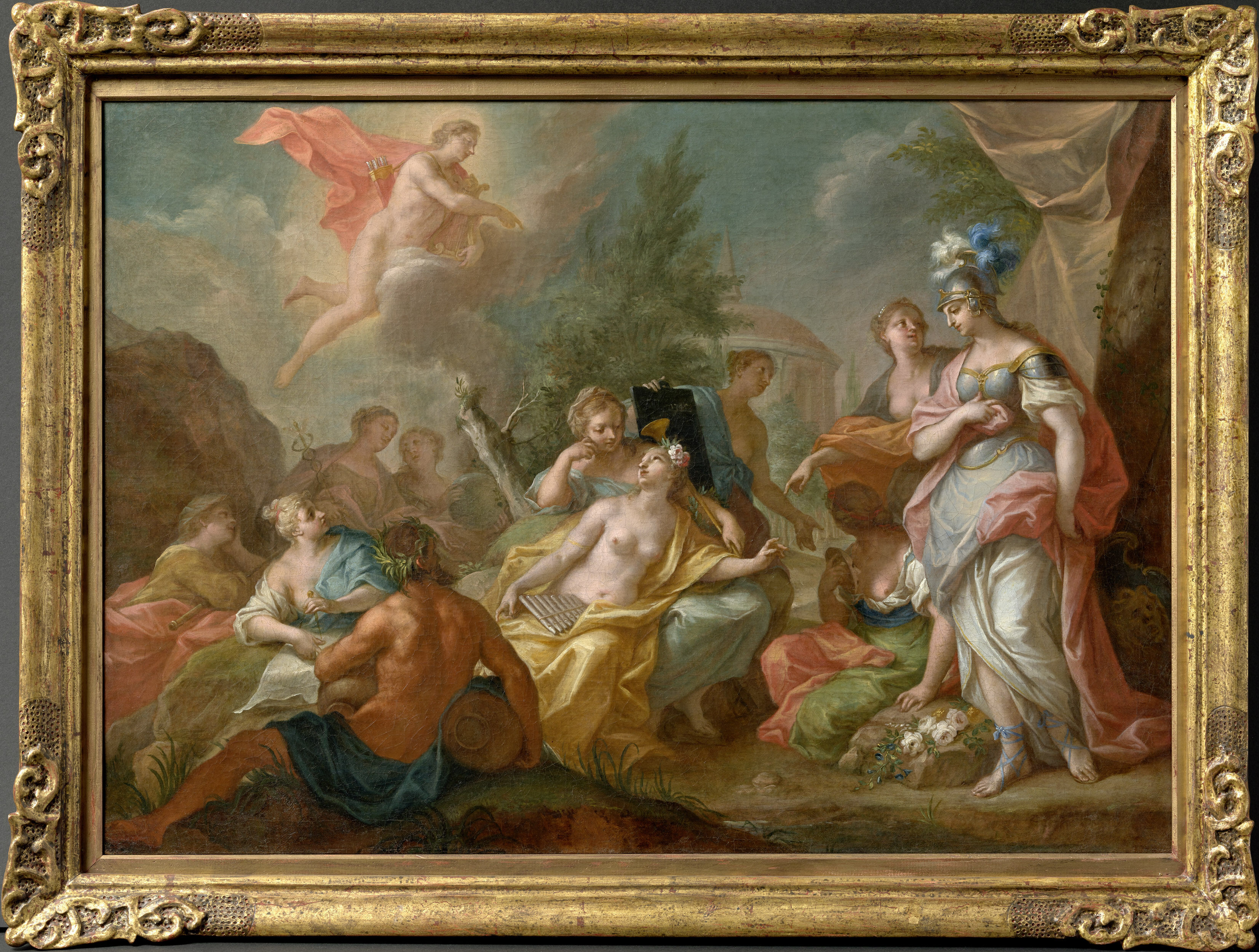
Apollo and the Muses
Johann Georg Bergmüller (1688 - 1762)
Framesize 73.00 x 97.00 x 5.00 cm
Private collection; 15.2.1963, acquisition, Residenzgalerie Salzburg
JUFFINGER 2010, vol. 1, p. 28
In a painting by Johann Georg Bergmüller (1688–1762), a prominent representative of the transition from southern German Baroque to Rococo, the nine Muses are depicted in a staged landscape, together with the goddess Minerva (Gr. Pallas Athene] and the god Apollo. The protagonists adopt a variety of poses, and the impression of a tableau is reinforced by a curtain drawn back behind a rock on the right-hand side. The artist has placed accents of colour with red, blue and yellow draperies artfully arranged to cover the figures.
The Muses are gathered in groups, conversing, pondering, performing various tasks, or simply gazing at the Olympian goddess. Due to the variety of their attributes, they are only vaguely identifiable. The following attributions are possible, starting from Minerva on the far right: standing beside her, Terpsichore (or Euterpe), seated before her, Thalia, holding a mask. In the background with the tablet, Calliope, and before her, each holding a musical instrument, Euterpe (or Terpsichore) and Erato. Sitting on the left of the river god is Urania, then Melpomene, and behind them Polyhymnia with caduceus and Clio with globe.
As described in Hesiod’s Theogony, the Muses reside on Mount Helicon, in Bœotia. Their ritual place below the eastern summit is indicated here by the round temple in the background. On the left, his back to the viewer, a river god reclines on a bank – a symbol of the sacred spring Hippocrene, created when the winged horse Pegasus struck the ground with his hoof, as Ovid (43 BC –17 AD) tells in his Metamorphoses (V, 250–271).
Hovering above the scene is Apollo, god of light, beauty, music, poetry and prophecy. His attributes make him leader of the Muses. He is often – as here – depicted naked, with lyre, quiver and a scanty cloak. His appearance remains consistent through the periods of art history: mostly youthful, well-proportioned and physically attractive.
As god of prophecy, Apollo has his sanctuary in Delphi, north-west of Mount Helicon, at the foot of Mount Parnassus in the region of Phocis. The Castalian Spring near the inner precinct served for ritual cleansing and was regarded as the favourite haunt of Apollo and the Muses.
Translated catalogue text from:
Habersatter Thomas: Die Musen. In: Astrid Ducke: Der Kuss der Musen. Festspiele göttlicher Inspiration. Residenzgalerie Salzburg. Salzburg 2020, S. 17-23, Johann Georg Bermüller, Apollo und die Musen, S. 17-20, Abb. 7, S. 16
Translation: Gail Schamberger MA, Salzburg
More artworks by Johann Georg Bergmüller
Download of this artwork is permitted for private use only.
Here you will find our license for non-commercial use.