
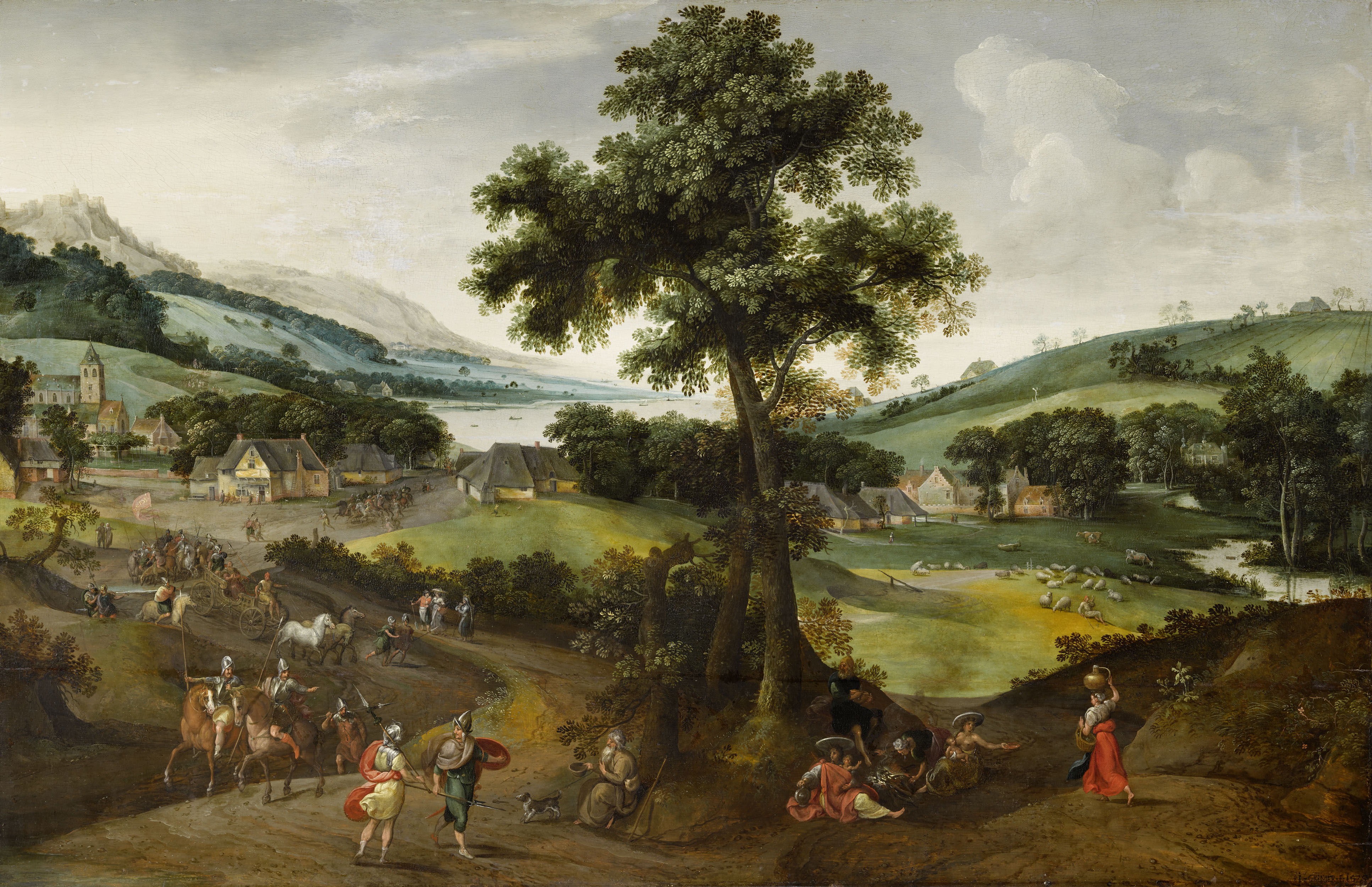
Landscape with Figures
Framesize 102.50 x 147.50 x 9.00 cm
Donath, Paris; 18.2.1941, Welz, Paris; 8.12.1942, Landesgalerie, LG 338; 1943, Bergung St. Gilgen (Recovered, St Gilgen); 11.10.1949, SMCA (in our days: Salzburg Museum); after 1952 transferred to Residenzgalerie Salzburg
JUFFINGER, PLASSER 2007, pp. 190-191
JUFFINGER 2010, vol. 1, p. 89
The landscape as an independent motif first appeared in panel paintings in the Netherlands. Joachim Patinir (c 1480–1524), who worked in Antwerp, is regarded as the founder of Dutch landscape painting. After meeting him in person in 1521, Albrecht Dürer (1471–1528) praised him in his journal as a “landscape painter”. Around 1526/1530, drawing on the background landscapes of Hieronymus Bosch (c 1450–1516), Patinir developed “world landscapes” – panoramic landscapes showing a wide stretch of countryside from a bird’s-eye view.
Over the ensuing decades, the viewpoint shifted further downwards, as in the Landscape with Staffage (1575) by Jacob Grimmer (1525/1526–c/after 1590). The Antwerp artist was a contemporary of Pieter Bruegel the Elder (c 1526/1530–1569), who brought Flemish landscape painting to its peak, and whose seasonal paintings in the Kunsthistorisches Museum in Vienna offer an exemplary insight into his work.
Grimmer painted only landscapes. Contemporaries appreciated his views, structured by rolling hills, with farmsteads and villages, forests, meadows, fields, rivers, paths and staffage figures, offering a view into a hazy distance, as in this picture. Individual details, such as the village, farmhouses and hilly landscape, are reminiscent of his Brabant homeland. It is nevertheless an imaginary world, painted with great fantasy and offering only an approximation of reality.
In contrast to the painting by Bordone (inv. no. 295), where the pictorial planes are layered and thus distinct, in Grimmer’s picture a winding path leads from the village square on the left into the foreground. This connects the individual landscape planes, convincingly representing the pictorial space as a unified whole and resulting in a continuity of depth. The colouration, however, still follows Bordone’s multilayered structure, with varying shades of brown, green and blue.
The central motif is the tree, with its bushy, dark green crown standing out against the overcast sky. Downhill to the right, a flock of sheep grazes on a riverside meadow.
This type of representation already shows the basic features of 17th-century Dutch landscape painting, even though the horizon is still far too high and the substantiality of the landscape with all its (natural) phenomena is far from being achieved.
Grimmer shows a charming, almost idyllic landscape – not quite in keeping with the band of soldiers marching along the road. This may be a reference to the fighting that broke out in 1568 (some time before the picture was painted) between the northern provinces and the Spanish crown, to end eighty years later with the recognition of the Republic of the United Netherlands, known as “Holland”. In these turbulent times, marauding troops ravaged and plundered entire regions, spreading terror amongst the population.
The detailed staffage figures, whose draperies add colourful accents, were sometimes executed by Lucas van Valckenborch (1535/1536–1597) or Gillis Mostaert (1528–1598); the high quality in this painting might indicate the work of Valckenborch.
Translated catalogue text from:
Habersatter Thomas: Natur wird Bild. Die flämische Landschaft. In: Thomas Habersatter, Ducke Astrid (Hrsg.): Natur wird Bild. Österreichische Barocklandschaften. Residenzgalerie Salzburg. Salzburg 2021, S. 17–29, Jakob Grimmer, Landschaft mit Staffage, S. 19, 20, 23, Abb. 2, S. 21.
Translation: Gail Schamberger MA, Salzburg
Download of this artwork is permitted for private use only.
Here you will find our license for non-commercial use.