

School of Athens, Painting after Raphael (1483 – 1520), Stanza della Segnatura, from 1509, Fresco, Vatican Palace, Rome
Framesize 85.00 x 112.00 x 5.00 cm
1776, Archbishopric Salzburg; Klessheim Palace (Archduke Ludwig Viktor); Estate Archduke Ludwig Viktor, Klessheim Palace; 1921, Province of Salzburg 1111119300197 (1111130435); 5.7.2019, Residenzgalerie Salzburg
JUFFINGER 2011, vol. 1, p. 230
JUFFINGER 2019, pp. 88-90, 127, 129, illus. 39, 39a
The work of Raphael (1483–1520) had lost none of its appeal during the Baroque period. One of his major works, in the Vatican Palace in Rome, is the series of frescos in the Raphael Rooms – four rooms, where the decoration was begun under Pope Julius II (1443–1513, Pope from 1503) and which were intended as a prestigious extension of the private apartments.
Nicola Bonvicini made four paintings for the wall panels in the "Stanza della Segnatura", which served as library and studiolo. The four murals are assigned to the four faculties reflecting the learning of the age: philosophy, theology, poetry and justice. They illustrate the programme of a papal rule based on justice and learning, and thus on the highest degree of scholarship.
Salzburg Archbishop Hieronymus Colloredo (r 1772–1803/1812) displayed all four paintings in his Residenz.
The "School of Athens" is probably Raphael's best-known work. In the centre, at the top of the steps, Plato and Aristotle emerge from the temple. In the front-facing architectural niches are statues of Apollo and Athene, tutelary gods of the Arts and Sciences. Plato, pointing up to heaven with his right hand, holds the "Timaeus" under his left arm. His counterpart Aristoteles, holding the "Ethica", points downwards to the material world. All the other figures grouped round these two protagonists represent philosophers and mathematicians of the ancient world, or may be associated with eminent contemporaries of the artist. Plato has Leonardo da Vinci's facial features; the thinker (Heraclitus) leaning on the stone block in the foreground has those of Michelangelo. In keeping with the iconographic programme, the wall areas show the personification of Philosophy.
Translated catalog text from:
Habersatter Thomas: Vier Gemälde nach Raffael, Stanza della Segnatura, Vatikanpalast, Rom, 1776. Parnass, Schule von Athen, Tugenden, Disputa del Sacramento. In: Gratz Reinhard, Mitterecker Thomas (Hg.): Fürsterzbischof Hieronymus Graf Colloredo. Reformer in neuem Licht. 1772-1803/1812. Ausstellungskatalog Dommuseum Salzburg. Salzburg 2023, S. 248-251
Translation: Gail Schamberger MA, Salzburg
More artworks by Nicola Bonvicini (Buonvicini)
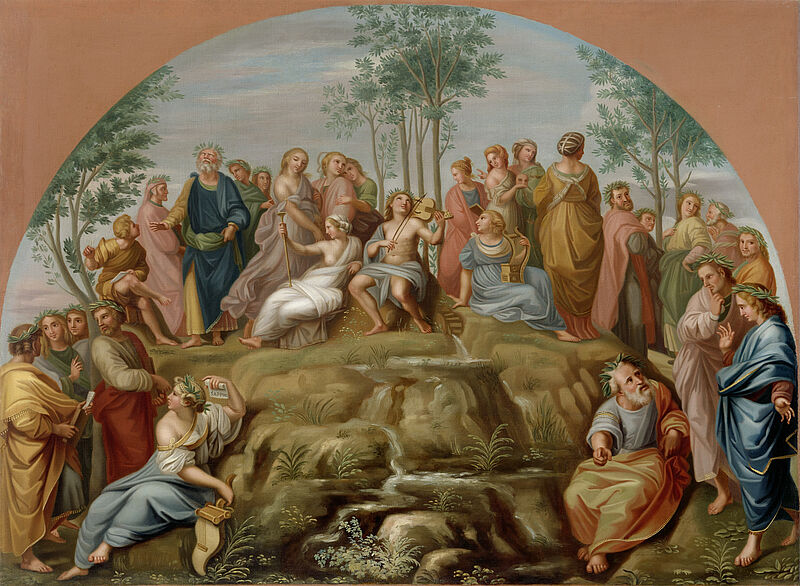
Parnassus, Painting after Raphael (1483 – 1520), Stanza della Segnatura, from 1509, Fresco, Vatican Palace, Rome, 1776
Nicola Bonvicini (Buonvicini)
Inv. no. 652
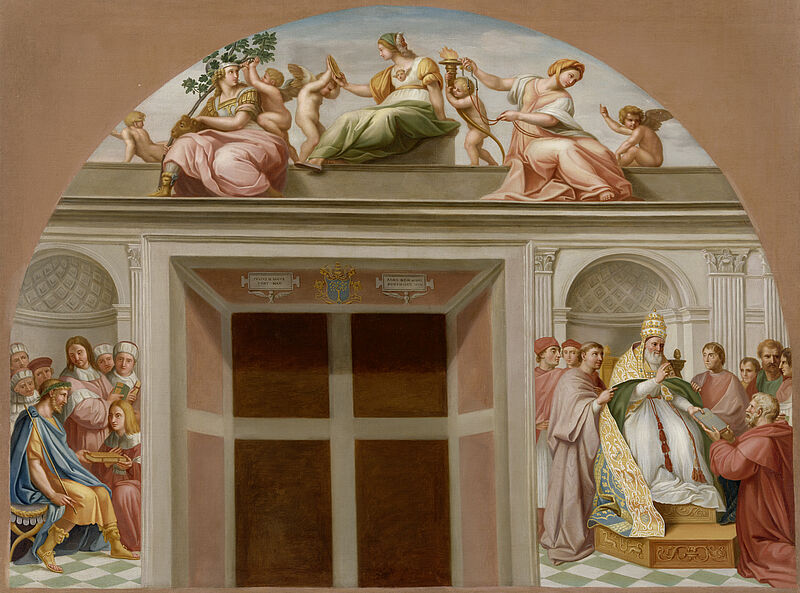
Lunette: Virtues: Fortitude (Fortitudo), Prudence (Prudentia), Temperance (Temperantia), bottom left: Handing over of the Pendects (Corpus iuris civilis) to Emperor Justinian, bottom right: Handing of the Decretals (Corpus iuris canonici) to Pope Gregory IX., Painting after Raphael (1483 – 1520), Stanza della Segnatura, from 1509, Fresco, Vatican Palace, Rome, 1776
Nicola Bonvicini (Buonvicini)
Inv. no. 654
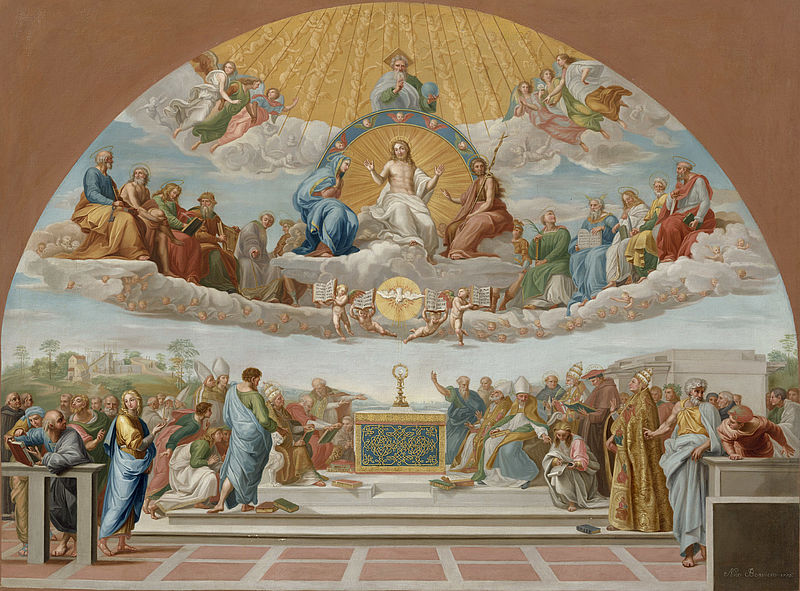
Disputation of the Sacrament, Painting after Raphael (1483 – 1520), Stanza della Segnatura, from 1509, Fresco, Vatican Palace, Rome, 1776
Nicola Bonvicini (Buonvicini)
Inv. no. 655
Download of this artwork is permitted for private use only.
Here you will find our license for non-commercial use.